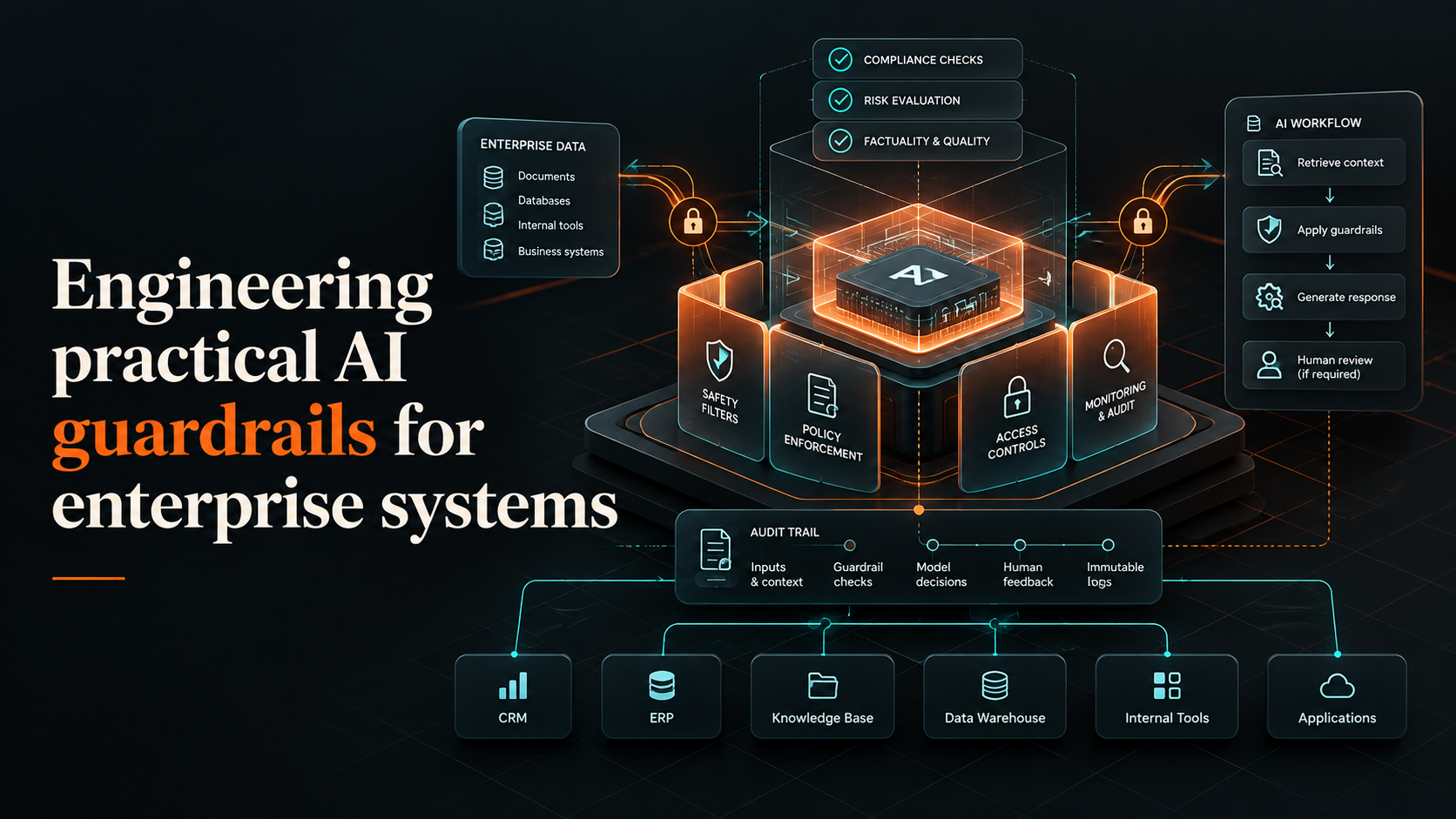
AI can unlock real productivity across enterprise systems, but only when it operates inside clear, reliable boundaries.
A proof of concept can tolerate occasional mistakes. A production system cannot.
When AI is connected to internal data, enterprise applications, customers, financial workflows, or regulated processes, failures become expensive. A model may generate incorrect information, expose sensitive data, take an unauthorized action, or produce inconsistent output that breaks downstream systems.
This is why practical AI guardrails are becoming a core engineering requirement.
Why AI guardrails matter
Enterprises are moving quickly from AI experiments to AI-enabled workflows in support, operations, finance, knowledge management, internal tools, and decision support.
The model itself is only one part of the system.
For AI to operate reliably in production, the surrounding architecture must make its behavior:
- predictable,
- governable,
- observable,
- auditable, and
- constrained by enterprise policy.
That is the role of guardrails.
What are AI guardrails?
AI guardrails are the technical controls, policies, and validation mechanisms that shape how an AI system behaves before, during, and after a model interaction.
They are not a single feature.
They are a layered engineering approach that helps ensure the system:
- uses the right context,
- respects user permissions,
- follows business policies,
- produces acceptable outputs,
- avoids unsafe or unauthorized actions,
- supports human review when required, and
- leaves an audit trail.
Good guardrails do not make AI less useful.
They make it dependable.
The goal: practical, not theoretical
Many discussions around AI safety are broad and abstract.
Enterprise teams usually face more immediate questions:
- Can this assistant see only the data the user is authorized to access?
- Can we stop it from inventing answers when evidence is missing?
- Can we prevent sensitive information from being exposed?
- Can we require approval before a high-risk action is executed?
- Can we trace which data and policies influenced a response?
- Can we explain what happened during an audit?
Practical guardrails are designed around these operational concerns.
The five core layers of enterprise AI guardrails
A robust enterprise AI system typically applies controls across five layers.
1. Access and identity guardrails
AI should operate under the same identity and access rules as the rest of the enterprise.
That includes:
- authenticated users and service accounts,
- role-based or attribute-based access control,
- permission-aware retrieval,
- restricted tool access,
- separation between development, UAT, and production.
If a user cannot access a document directly, an AI assistant should not be able to retrieve or summarize it on their behalf.
The AI layer should never become a shortcut around existing authorization rules.
2. Input guardrails
Input guardrails validate requests before they reach the model or external tools.
Typical controls include:
- prompt injection detection,
- malicious instruction filtering,
- content and file validation,
- sensitive-data detection,
- request-size limits,
- rate limiting,
- workflow-specific usage rules.
This becomes especially important when systems accept uploaded files, web content, emails, documents, or other untrusted sources.
Untrusted content should be treated as data, not as authoritative instructions.
3. Context guardrails
Enterprise AI often relies on retrieval-augmented generation, internal databases, APIs, documents, and knowledge bases.
The system therefore needs controls over what information reaches the model.
Context guardrails may include:
- permission-aware retrieval,
- approved-source filtering,
- metadata constraints,
- freshness checks,
- relevance thresholds,
- document ranking,
- citation requirements.
The goal is not simply to give the model more context.
It is to give it the right context.
Without these controls, a system may produce a confident answer from irrelevant, outdated, or unauthorized information.
4. Output guardrails
The model response should be validated before it is displayed, stored, or used by another system.
Output controls can include:
- policy checks,
- PII and confidential-data detection,
- unsupported-claim detection,
- content-safety checks,
- schema validation,
- formatting validation,
- action approval rules.
For example:
- a finance assistant may require every claim to be source-backed,
- a workflow integration may require valid JSON,
- a customer-facing response may require policy validation,
- a system-changing action may require explicit approval.
This is where AI moves from being a text generator to becoming a controlled enterprise component.
5. Monitoring and audit guardrails
Enterprise AI must be observable.
Teams need to understand what happened, what data was used, what policies were applied, and what action was taken.
A useful audit trail may capture:
- user identity,
- request metadata,
- retrieved sources,
- applied guardrails,
- model and model version,
- validation results,
- human approvals,
- external actions,
- final output status.
The organization must still apply appropriate privacy and retention policies to logs.
But without traceability, debugging, compliance, and incident investigation become extremely difficult.
A practical guardrail architecture
A common enterprise flow looks like this:
User / Application
        ↓
Authentication + Authorization
        ↓
Input Validation + Policy Checks
        ↓
Permission-Aware Context Retrieval
        ↓
Model Orchestration
        ↓
Output Validation
        ↓
Human Review, if required
        ↓
Response or Action
        ↓
Monitoring + Audit Trail